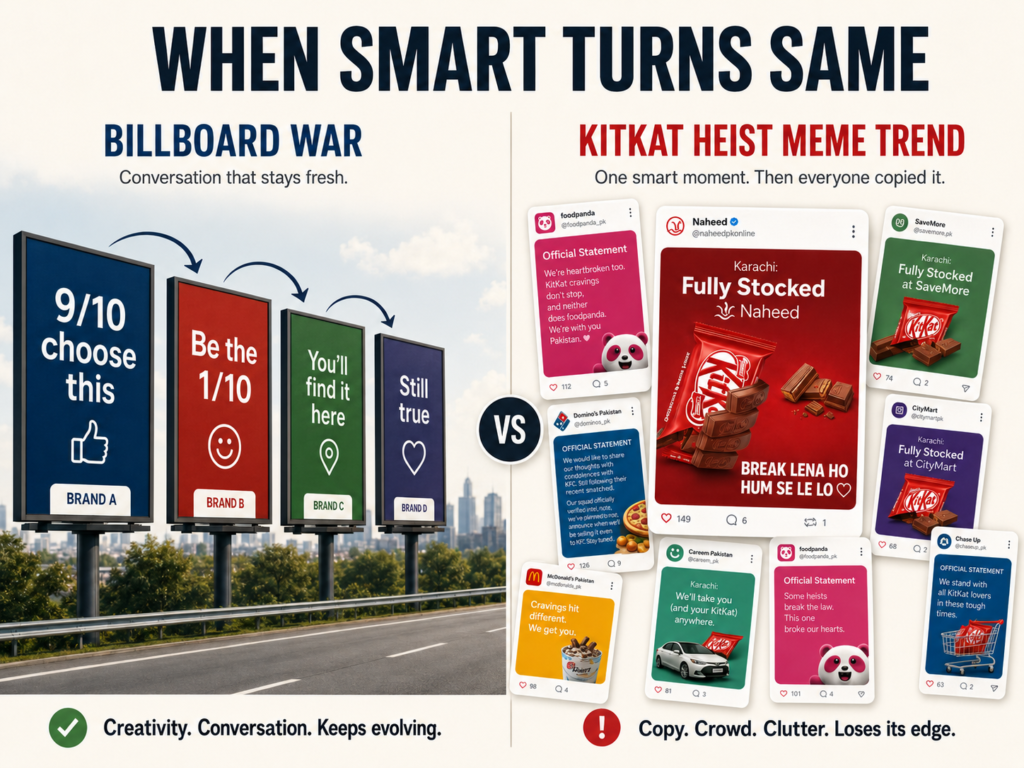
A lot of Pakistani brands are trying to stand out and somehow ending up in the exact same crowd.
They jump on the same trends, use the same humour, and rush to join the same cultural moments. The content may feel timely, but after a while, it all starts sounding familiar.
This is not a creativity problem. It is a sameness problem.
The problem is not the trend. It is the pile-on.
A trend can work brilliantly when the first brand gets there with speed, wit, and the right tone.
That is why the KitKat theft moment worked. It was odd, timely, and easy for the brand to own. But once every other brand started making the same joke, the moment lost its edge. What felt clever at first quickly became crowded.
That is usually how brand distinctiveness disappears. One brand creates a moment. Everyone else turns it into a template.
Karachi’s billboard battle proved the same thing
The recent billboard exchange in Karachi made the same point. Shan made the first move. Falak responded well. Then more brands joined in.
The first few responses were sharp and fun. But once every brand starts adding its own version, the idea begins to lose freshness. The audience may still enjoy it, but the brands become harder to tell apart.
There is a difference between joining a moment and overcrowding it.
If you want a better example of lasting brand memory in Pakistan, look at Ufone.
People still remember Ufone’s ads because they had a clear comic style that felt unique to the brand. The humour was not memorable because it was trendy. It was memorable because it felt recognisably Ufone.
That is the real goal.
Not just being funny. Not just being fast. Being recognisable.
Why brands keep falling into this trap
Because sameness is easier to approve.
A familiar joke feels safer than an original one. A proven format feels safer than a distinctive voice. Trends give brands a shortcut to relevance, so they never have to stop and ask what they actually sound like.
That may help with reach for a moment. It does far less for memorability.
If your post could work with another brand’s logo on it, it is not strong brand storytelling.
How to fix it
Before jumping into a trend, ask:
Does this actually sound like us?
Are we adding something new, or just adding to the noise?
Would people recognise this as our brand without the logo?
Will they remember us, or just the reference?
The strongest brands know their voice, know when a moment fits, and know when to sit one out.
That last one is underrated.
Final thought
Most Pakistani brands do not sound the same because they are boring. They sound the same because too many are borrowing the same timing, tone, and shortcuts to relevance.
The answer is not to be louder or faster.
It is to be more recognisable.
Because the brands people remember are not the ones that jump on every moment. They are the ones that still sound like themselves when everyone else is busy sounding like each other.