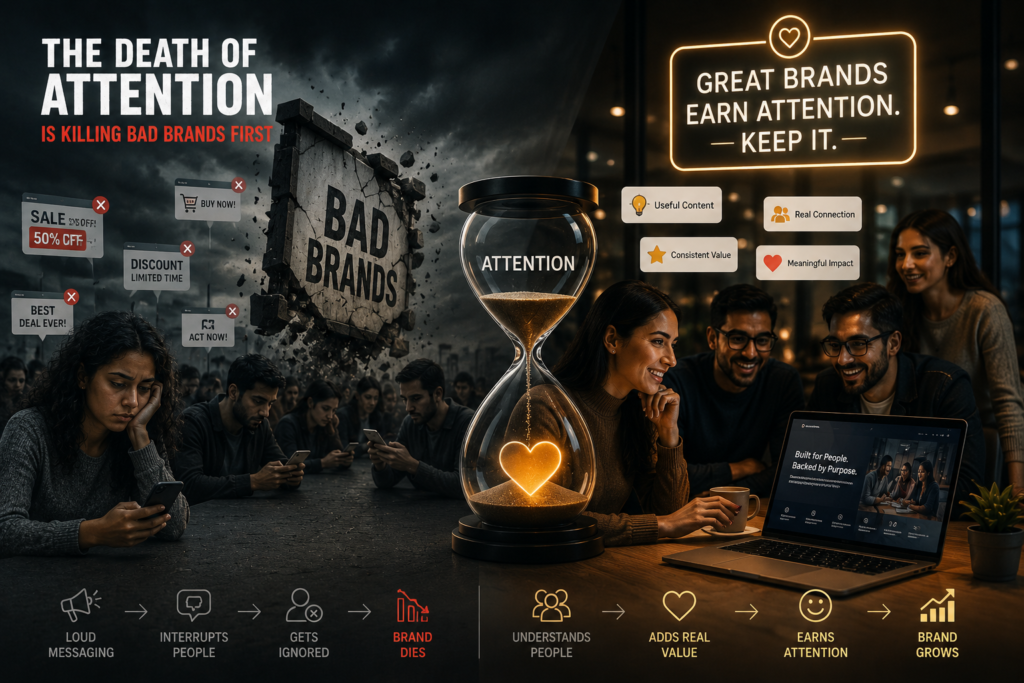
People haven’t lost the ability to pay attention. They’ve become extraordinarily good at filtering.
Every day, the average human encounters thousands of pieces of content. The brain — brilliant, ruthless, efficient — decides in milliseconds what deserves processing and what gets scrolled past. This isn’t distraction. This is survival.
And most brand content is not surviving it.
The narrative that “nobody has attention anymore” is a convenient excuse for brands that are, if we’re being honest, genuinely boring. TED Talks still hold audiences for 18 minutes. Long-form podcasts have never been more popular. People binge eight-hour documentary series on weekends.
Attention is not dead. Tolerance for mediocrity is.
What scroll culture has actually done is compress the window of judgment. You have two seconds to earn the next two seconds. Then two more. Attention is not given — it’s renewed, moment by moment, based on one question: is this worth my time?
Clarity beats complexity. Always. A brand that knows exactly what it stands for, communicates it without apology, and delivers it in a way that respects human intelligence — that brand never has an attention problem.
The brands struggling with reach are not struggling because the algorithm changed. They’re struggling because they optimized for impressions instead of impact. Because they said something safe instead of something true. Because they designed content for approval instead of for humans.
Entertainment is not the opposite of business. In a world fighting for attention, entertainment is a business strategy.
Your audience is not distracted. They’re just waiting for a reason to stop.